🎬🌱 CinéAction – Erasmus+ Mobility in Bursa, Turkey
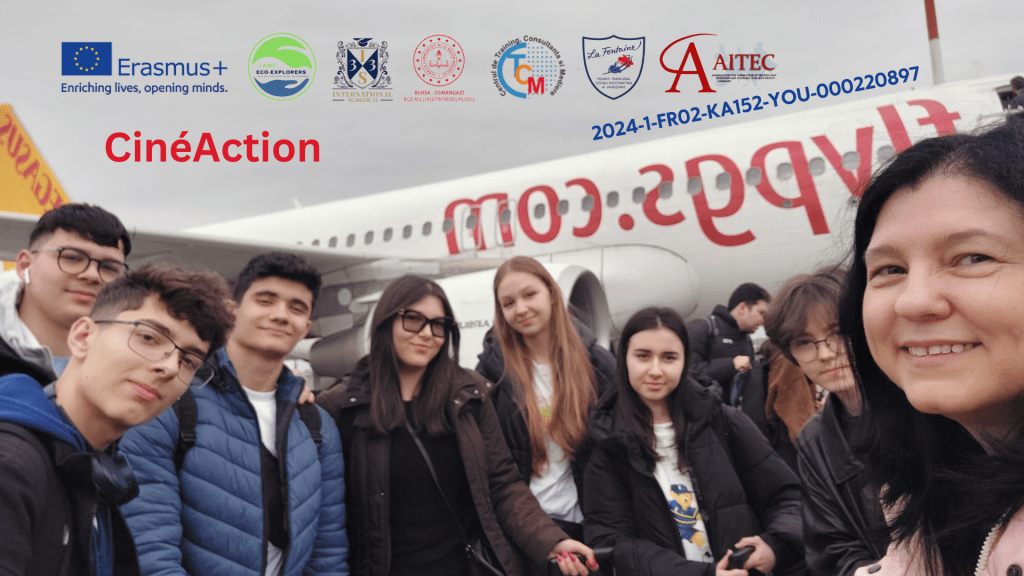
The CinéAction: Promoting Environmental Awareness Through Cinema mobility, carried out in Bursa within the Erasmus+ project JANE – Eco-Explers: Youth in Action for Nature and Environment, emerged as an experience that clearly went beyond its formal-institutional dimension, becoming a genuine learning environment in which education, creativity, and reflection were articulated within a coherent and deeply transformative dynamic.
From my perspective as a teacher participating in this mobility, as well as the Romanian project coordinator and founding president of the CTCM Association – Mediation, Consulting and Training, Center — a partner organization in the project — this experience gained an additional level of depth through the overlap of responsibilities, reflection, and engagement.
On the one hand, the mobility provided a direct framework for observing and understanding how young people learn in non-formal contexts, through active involvement and international collaboration. On the other hand, it became a space for pedagogical analysis and for validating educational practices that move beyond traditional teaching models, focusing instead on the development of complex and transferable competences.
In this context, travel was not reduced to a simple movement or a sequence of activities, but functioned as a meaningful learning experience capable of generating simultaneous transformations at cognitive, creative, and identity levels. It involved not only the education of perception, but also the development of creativity, critical thinking, and civic awareness, contributing to a more nuanced understanding of the world and of otherness.
This transformation unfolded progressively within a carefully structured pedagogical framework, in which each stage contributed to deepening the experience. From the formation of international teams to the creation of final products, the process followed a logic of transition from participation to engagement and from experience to expression. Learning was not transmitted, but constructed, and this was reflected in the way participants assumed active roles in the creative process.
The cinematic dimension of the project provided a particularly relevant framework for this transformation. The process of creating short films required not only technical skills, but also the ability to select, interpret, and construct meaning. From this perspective, participants became not only content creators but also mediators of reality, capable of translating experience into a coherent and meaningful visual language.
As a teacher and the Romanian project coordinator, I was able to observe how this type of activity stimulates the development of critical thinking. The need to make decisions, justify choices, and construct a final product generated an authentic process of reflection and responsibility. Creativity was not an end in itself, but a means of understanding and expression.
The intercultural dimension of the mobility was equally significant. Working in international teams created a space of cultural mediation in which differences were not diminished, but valued. From my perspective as a coordinator and trainer, this confirms the importance of integrating intercultural experiences into students’ education, not merely as exposure, but as an active process of negotiation and reconstruction of meaning.
At the same time, the civic dimension of the experience developed organically in relation to the project’s theme. Environmental education did not remain at a theoretical level but was integrated into activities that encouraged awareness and engagement. From an organizational perspective, this approach confirms the relevance of Erasmus+ projects as tools for developing active, responsible, and engaged young people.
A key moment of the experience was the return and the process of dissemination. The event organized at the “Radu Rosetti” Municipal Library in Onești represented not only a stage of project valorization, but also a moment of collective reflection. The participating students — volunteers of the CTCM Association Onești and students of the “Grigore Moisil” National College — succeeded in transforming their lived experience into a coherent and meaningful discourse for the local community.
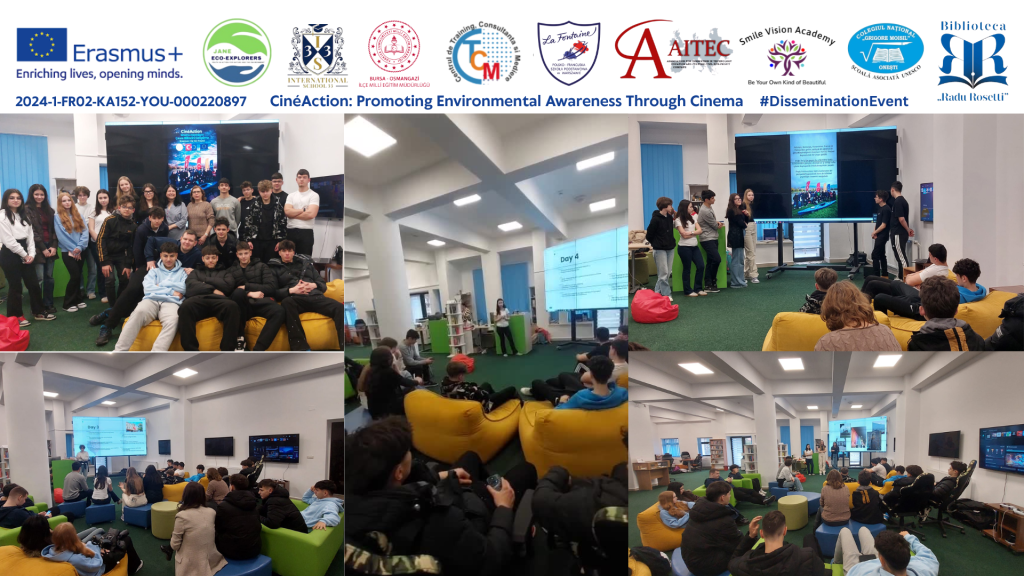
From this perspective, dissemination can be understood as a form of cultural mediation and as an extension of the learning experience. Participants did not simply transmit information, but reconstructed and interpreted their experience, becoming active actors in the educational process.
In light of these observations, the Erasmus+ mobility in Bursa can be considered a relevant example of good practice in non-formal and intercultural education. It demonstrated that learning becomes truly meaningful when it is lived, reflected upon, and shared.
For me, this experience also had a confirmatory value: it validated that the directions we are developing within the CTCM Association — in terms of training, mediation, and competence development — are not only relevant, but essential in a continuously evolving educational context.
Ultimately, what remains of this mobility is not only the experience itself but also the way it continues to generate meaning, inspire, and open new perspectives. Because the true value of such an experience is measured not only by what was achieved, but by what becomes possible afterward.
#ErasmusPlus #YouthExchange #JaneEcoExplorers #EnvironmentalAwareness #CinemaEducation #CinéAction #GlobalCitizenship #Bursa #CTCMAssociation #Dissemination

 Virginia Brăescu